User-Centered HMI and Control Design for eVTOL Vehicles
Minimizing Mental Mode Shifts Between Driving and Flying
In progress.
Tools: Figma, Adobe AI PS AE, UE 5, Solidworks, Blender, Alias, Keyshot

Interactive
Cockpit
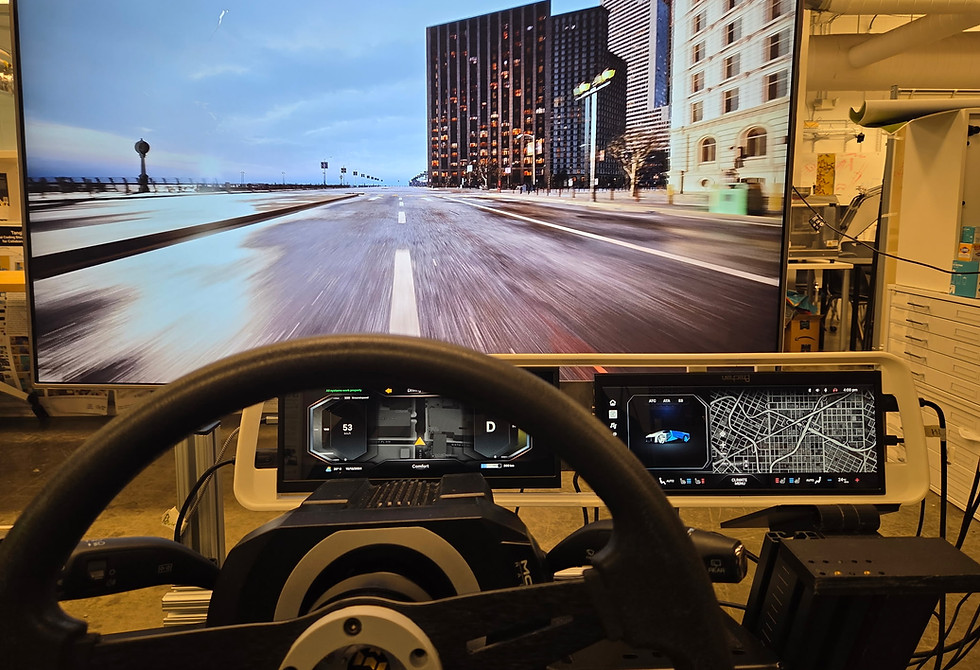
Driving mode
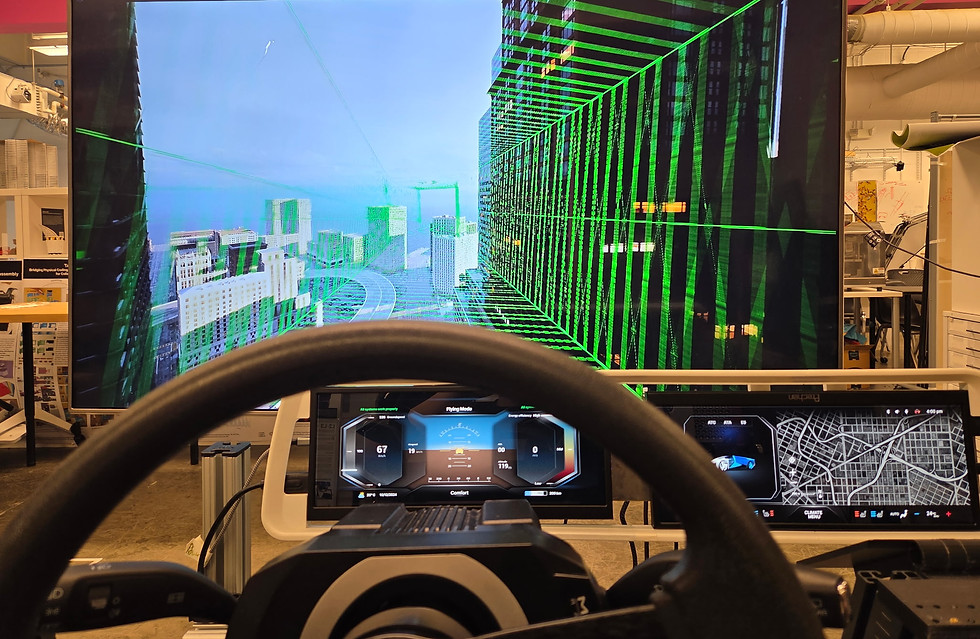
Flying mode
-
Designed an integrated eVTOL HMI and control system to help drivers with no prior flight experience transition between ground driving and flight with less cognitive effort.
-
Interviewed four aviation and human-factors experts and user representatives to understand flight controls, cognitive workload, automation trust, and novice learning barriers.
-
Developed a three-stage research framework covering concept exploration, usability evaluation, and integrated simulator testing, initially planned for approximately 55 participants.
-
Mapped the complete urban and suburban journey from ground driving and vertiport arrival to mode transition, takeoff, aerial navigation, and landing.
-
Designed and compared one driving interface and four flight-interface directions, exploring instrument hierarchy, maps, HUD guidance, aerial corridors, rotor status, and warning feedback.
-
Approximately 28 concept responses showed that the circular compass received twice as many votes as the linear alternative, while animated color-frame alerts scored above 4.2/5.
-
Explored two control-system directions and created eight physical prototypes to evaluate grip posture, thumb support, button placement, pivot alignment, and cross-mode interaction.
-
Increased critical edge radii to at least 6 mm, shortened the joystick by approximately 10%–15%, and refined palm-contact areas and button angles based on user feedback.
-
Built an interactive simulator in Unreal Engine 5 using Blueprint, implementing vehicle controls, driving-to-flight transitions, real-time parameters, aerial corridors, maps, and navigation logic.
-
During high-fidelity testing with six non-pilot drivers, four of six found the mode transition relatively easy, with an average NASA-TLX score of approximately 11/20. The final system combined one steering wheel, two shared pedals, and one side-stick.